The 35,000-Decision Day: Why Great Leaders Make Fewer Choices
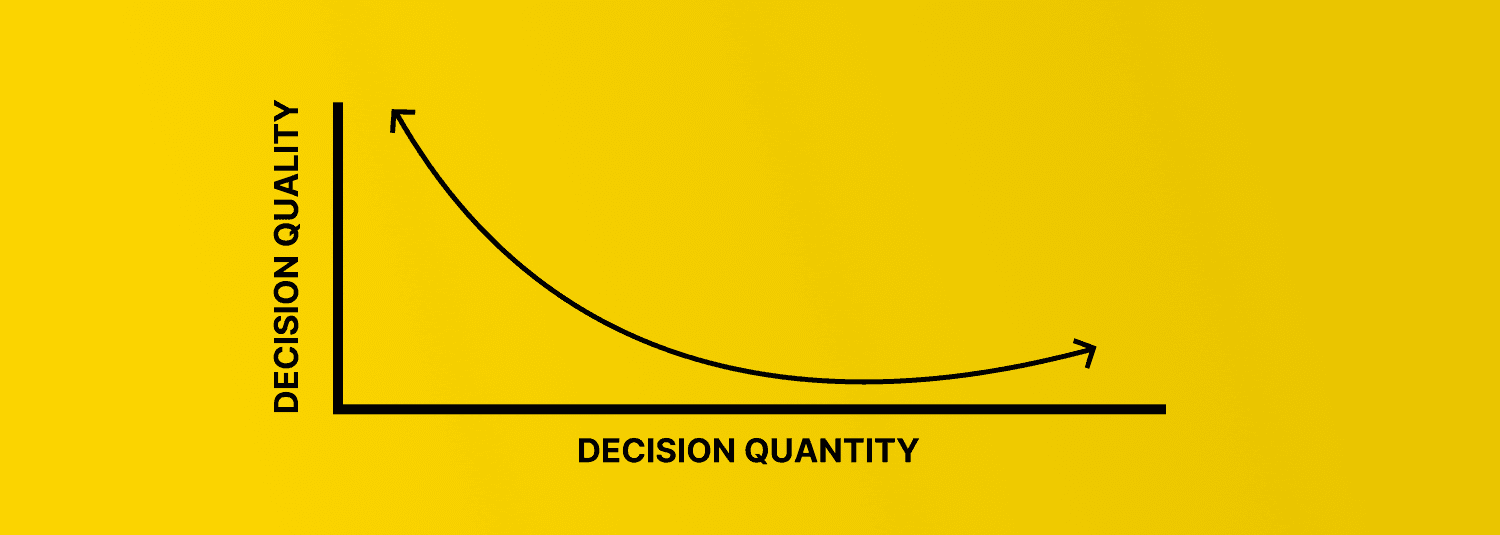
The average person makes 35,000 decisions each day. For leaders, that number climbs significantly higher, CEOs face roughly 50 high-stakes decisions daily. But here’s what the research reveals: the best leaders aren’t making more decisions. They’re strategically making fewer.
Share this post
The Cognitive Tax
Decision-making isn’t free, it drains a finite cognitive resource. Research from the National Library of Medicine shows that each choice you make depletes mental energy, regardless of its significance. Whether you’re deciding on a $10 million investment or what to wear, your brain draws from the same limited reserve.
The consequences are measurable. A University of Cambridge study found that 60% of executives experience impaired judgment after prolonged decision-making sessions. McKinsey’s analysis of Fortune 500 companies revealed that executives waste 30% of their time on low-impact decisions, directly correlating with slower revenue growth. In healthcare settings, 42% of managerial errors, from misallocated resources to misdiagnosed priorities, stemmed from decision fatigue.
Perhaps the most striking evidence comes from parole boards. Judges granted parole at a 70% rate in the morning but less than 10% by afternoon, not because cases changed, but because their decision-making capacity had eroded.
The Elite Operator’s Response
Barack Obama wore only blue or gray suits during his presidency. Steve Jobs stuck to black turtlenecks and jeans. Mark Zuckerberg defaults to gray t-shirts. This isn’t about fashion, it’s about cognitive architecture.
“You’ll see I wear only gray or blue suits,” Obama explained. “I’m trying to pare down decisions. I don’t want to make decisions about what I’m eating or wearing. Because I have too many other decisions to make”. These leaders recognized a fundamental truth: trivial decisions consume the same mental energy reserved for critical choices.
The strategy extends beyond wardrobe. Research shows that structured decision-making frameworks reduce mental fatigue by 40%, freeing bandwidth for high-impact work. Task batching, grouping similar decisions into dedicated time blocks, minimizes the cognitive load of context switching and enables sustained focus.
Building Decision Systems
The antidote to decision fatigue isn’t willpower, it’s architecture. Leaders who schedule critical decisions during peak cognitive hours (typically morning) consistently outperform those who decide reactively throughout the day. A Harvard Medical School trial showed that leaders who exercised five times weekly reduced afternoon decision fatigue by 22% compared to sedentary peers.
The 70% certainty rule offers another framework: if you have 70% confidence in a direction, proceed rather than waiting for perfect information. This prevents decision paralysis while maintaining quality standards. The key is recognizing that clarity, not effort, produces optimal decisions.
Automation eliminates entire categories of choices. Meal planning removes daily food decisions. Capsule wardrobes eliminate morning deliberation. Email filters and calendar templates reduce administrative micro-choices that compound throughout the day. Each automated decision preserves energy for strategic thinking.
The Competitive Edge
Decision fatigue isn’t a personal weakness, it’s a physiological reality. The distinction between average performers and elite operators lies not in their capacity to decide more, but in their discipline to decide less. By eliminating low-value choices, batching similar decisions, and scheduling critical thinking during peak cognitive windows, high performers preserve mental capacity for the decisions that genuinely matter.
The question isn’t how many decisions you can make. It’s how many you can avoid.

Want more like this?
Get weekly insights on coach infrastructure.
More articles you may like
The Citation Test: Is Your Website AI-Readable?
When someone asks ChatGPT or Perplexity to recommend an executive coach, does your website get cited or skipped? In 2025, AI engines have become the new gatekeepers of professional discovery, and most coaching websites are structurally invisible to them.

The jagged frontier: Using AI without losing your edge
AI is already mainstream in business, but most organizations are still stuck in pilots, and that gap is where high-performers can separate. The real advantage isn’t “using AI”; it’s building an operating system where AI speeds up the right work, while judgment stays human.
The 50-Millisecond Test: Why Your First Impression Happens Before You Know It
You have 50 milliseconds to make a first impression online. That’s 0.05 seconds, faster than a blink, shorter than a heartbeat. In that microscopic window, visitors form judgments about your credibility, professionalism, and whether you’re worth their time. Research shows that 94% of those snap judgments are based entirely on design.